
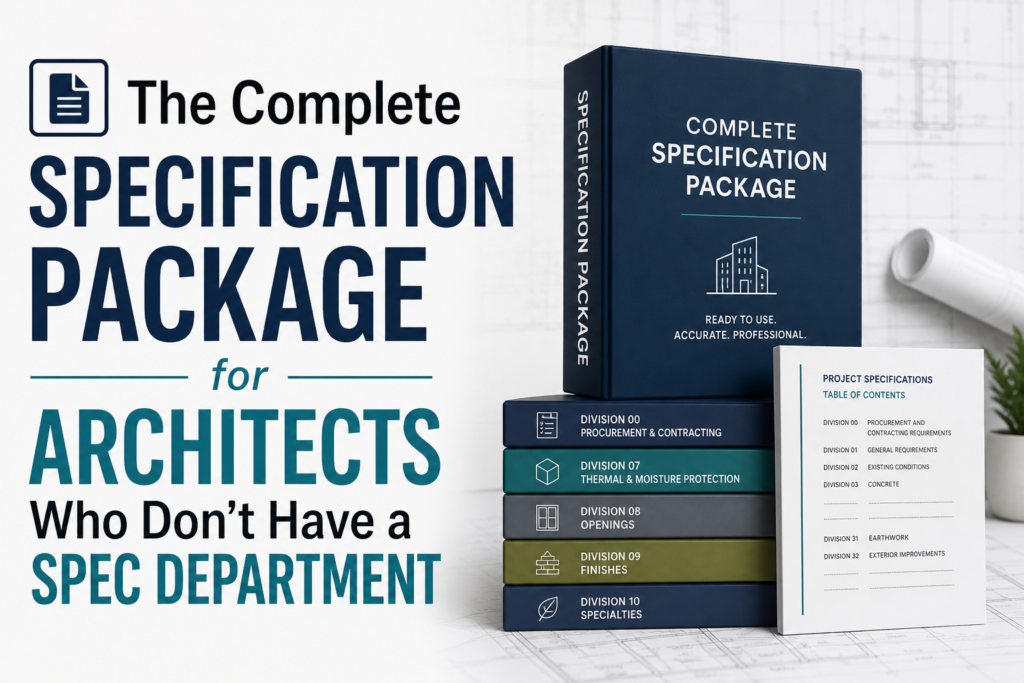
The Complete Specification Package for Architects Who Don’t Have a Spec Department
One purchase. No annual fee.
Download the Comprehensive Package — $1,499
You Do the Work of Five People. Your Specs Should Keep Up.
When you run a small firm or solo practice, you’re the designer, the project manager, the client liaison, and the specification writer — all before lunch.
The large firms have dedicated specifiers on staff. They have master spec libraries built over decades. They have subscription software with thousands of pre-written sections maintained by someone else.
You have a deadline.
That’s exactly why we built the Comprehensive Specification Package — a complete, professional, ready-to-edit library covering interiors, architecture, landscape, and everything in between, delivered in Microsoft Word. No subscription.
Buy it once. Use it on every project.
What’s Actually Inside the Comprehensive Package
Most specification products make you choose a lane — interiors or architecture or landscape. Real projects don’t work that way. A commercial tenant improvement has interior finishes, architectural assemblies, and an entry landscape condition. A residential addition touches all three.
The Comprehensive Package covers all four specification disciplines in one download:
Interiors Specifications Flooring, wall finishes, ceilings, millwork, specialty surfaces, acoustic treatments, and interior glazing systems. Everything from paint to polished concrete to wood veneer paneling — written to the standard your contractor and client expect.
Architectural Specifications Structural assemblies, exterior envelope, roofing, waterproofing, doors and hardware, windows, and building specialties. The core systems that define how a building performs and how it gets built.
Landscape Specifications Site preparation, grading, planting, irrigation, hardscape, exterior lighting, and site furnishings. Often the most overlooked portion of a project manual — and the one most likely to cause field disputes when it’s missing or vague.
Comprehensive Coverage The full package brings all three together so your project manual reads as one coordinated document — not three separate specs stapled together by a solo architect on a Sunday night.
Who This Package Is Built For
The solo practitioner who left a larger firm and suddenly realized the master spec library stayed behind. You know how to write specs. You’ve just never had to build a library from scratch — and you shouldn’t have to.
The small firm doing three to fifteen projects a year across multiple project types. A $2,500-per-year subscription made sense when your old employer was doing 80 projects. It doesn’t pencil out for your current volume. A one-time purchase does.
The architect adding landscape to their scope. Many smaller firms are taking on more comprehensive project scopes — full site, not just building. Having professional landscape spec sections ready to edit means you’re not writing those sections from scratch or leaving them out entirely.
The firm that inherited old master specs and isn’t sure what’s current, what’s outdated, and what’s quietly creating liability on every project you issue.
What a Professional Spec Package Actually Protects You From
Specifications aren’t administrative paperwork. They are legally binding contract documents that define what gets built, what materials are used, and what standard of installation is required. When something goes wrong in the field — and on every project, something does — your specification is the document everyone turns to.
A weak spec or a missing section protects no one. Here’s what’s actually at stake:
- – Substitution disputes. Without a clearly written Products section, contractors substitute freely. Sometimes the substitution is fine. Sometimes it’s not — and you find out at substantial completion.
- – Installation failures. A Part 3 Execution section that says “install per manufacturer’s recommendations” hands all quality control to the contractor. A real spec defines tolerances, preparation requirements, and inspection hold points.
- – RFI overload. Vague specifications generate requests for information. Each RFI costs you time to respond to and creates documentation you have to manage. Clear specs reduce RFIs before the project even breaks ground.
- – Liability exposure. If your drawings and your spec conflict, you’ve created a legal ambiguity that a contractor or their attorney will resolve in their client’s favor — not yours.
A professionally written starting point, properly edited for your project, closes these gaps before they open.
Why Microsoft Word — Not Proprietary Software
We made a deliberate choice to deliver every section as a .docx file. Here’s why that matters for your practice:
You already own Word. There’s no new software to purchase, no platform to learn, no IT support to involve. You open the file and start editing.
You can build your own master library. Download the package once and customize sections over time to reflect your firm’s standards, preferred manufacturers, and project type preferences. Over two or three projects, you’ll have a master spec that’s genuinely yours.
You’re not locked in. Proprietary spec platforms lock your content inside their system. When you stop paying, you lose access. Your Word files live on your server, your hard drive, your cloud storage — wherever you keep your project files.
You can share with consultants easily. Send a section to your MEP engineer or landscape architect for coordination without asking them to log into a platform they don’t have access to.
How Architects Are Using the Package
Project startup. Pull the relevant sections for a new project, do a quick edit pass to confirm manufacturers and project-specific requirements, and you have a working spec in hours instead of days.
Project type expansion. Taking on your first landscape-inclusive project? The landscape sections give you a professional foundation so you’re not writing irrigation or planting specs from scratch on a live project with a real deadline.
Firm master spec build. Use the package as the foundation for a custom master spec library. Edit each section to your standards once, save as your master, and pull from it on every future project.
Liability audit. Review your current project manual against the package sections to identify gaps — missing submittals language, vague execution requirements, substitution clauses that don’t protect you.
What You Get
- – Complete 3-part specification sections across interiors, architectural, and landscape disciplines
- – Microsoft Word format — fully editable, no restrictions
- – Organized by project discipline for fast navigation
- – Written to professional industry standards by experienced specification writers
- – One-time purchase — use on unlimited projects, no subscription required
- – Immediate download after purchase
The Math Is Simple
A specifications consultant charges between $1,000 and $12,000 to write a project manual depending on scope and complexity. A subscription spec platform runs $2,500 to $4,000 per year — every year, whether you use it or not.
The Comprehensive Package is a one-time investment you use on every project you take on from today forward.
Download the Comprehensive Specification Package →
If you’ve been piecing together specs from old project files, manufacturer cut sheets, and borrowed sections from other architects’ work — this is the upgrade your practice has been waiting for.
Frequently Asked Questions
The Comprehensive Package is designed to cover the full range of work typical to small and mid-size architectural practices — commercial interiors, light commercial construction, residential, mixed-use, and landscape-inclusive projects. If you have a highly specialized project type, contact us before purchasing.
All sections are written to current standards and reference current material and installation requirements. We recommend reviewing product-specific sections against current manufacturer data before issuing for construction, as product lines change.
Yes. The format and structure are consistent with industry-standard practice used on public and private projects. You are responsible for confirming compliance with any jurisdiction-specific or agency-specific requirements.
If your practice is exclusively interiors with no architectural or landscape scope, our Interiors Package may be the right fit. The Comprehensive Package makes the most sense when your projects regularly cross disciplines or when you want one complete library for any project that comes through the door.
Yes — visit this page to request a sample section so you can evaluate the writing quality, format, and depth before you buy.
Written by
Adam S.